
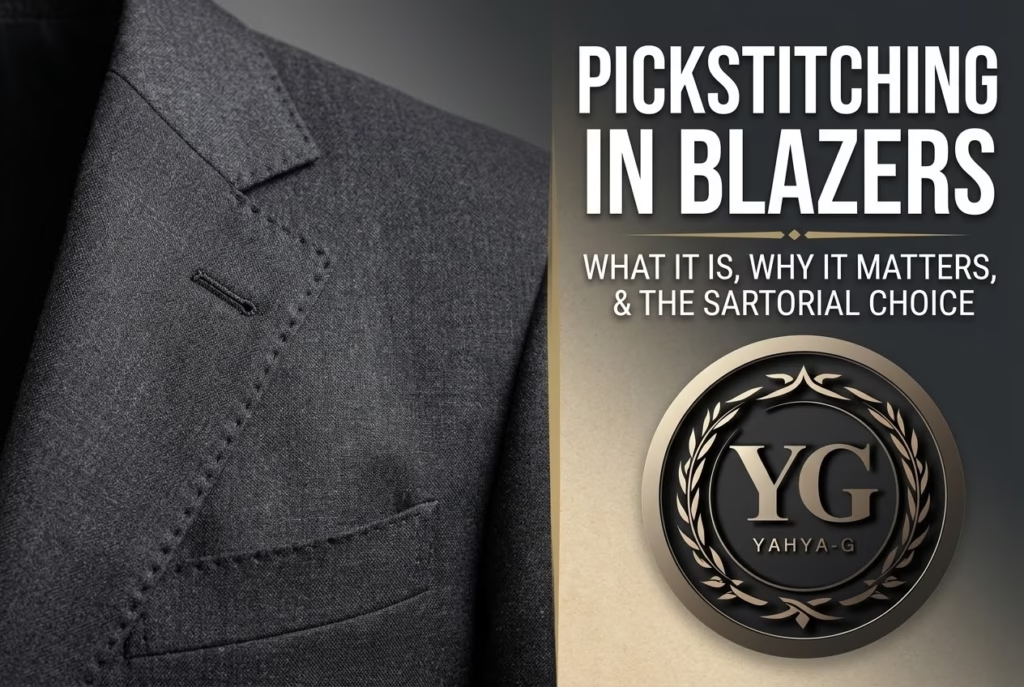
A truly exceptional blazer is defined by more than its fabric, color, or silhouette. Often, it is the smallest details that reveal the greatest level of craftsmanship.
Pick stitching is one such detail.
Those tiny, carefully spaced stitches running along the edge of a blazer’s lapels, front, pockets, or other edges may appear subtle at first glance. Look closer, however, and they reveal something important: attention to construction, finishing, and tailoring tradition.
For menswear enthusiasts, pick stitching is not simply a decorative feature. When thoughtfully executed, it can add character and definition to a blazer while reflecting the hand-finished approach associated with fine tailoring.
At Yahya G, where bespoke menswear combines traditional craftsmanship with contemporary style, details such as pick stitching are part of what separates an ordinary jacket from a carefully constructed tailored garment.
What Is Pick Stitching?
Pick stitching, sometimes written as pickstitching, is a decorative stitching technique used along the edges of a tailored jacket or blazer.
The stitches are typically positioned very close to the edge of the fabric, creating a subtle line that follows the contours of the garment. Depending on the design, pick stitching may appear on:
- Lapel edges
- Jacket fronts
- Pocket flaps
- Breast pockets
- Patch pockets
- Waistcoat edges
- Other selected garment details
The stitching can be almost invisible when viewed from a distance or deliberately emphasized with a contrasting thread.
Its appearance depends on the garment’s construction, fabric, thread choice, stitch spacing, and the tailor’s technique.
Is Pick Stitching Always Hand-Stitched?
Not necessarily.
Pick stitching can be produced by hand or by specialized machinery. In high-end bespoke tailoring, hand pick stitching is particularly valued because the tailor can control the spacing, tension, direction, and appearance of every stitch.
However, the presence of pick stitching alone should not be treated as proof that a blazer is handmade or bespoke.
Quality tailoring is determined by the complete garment—its fit, construction, finishing, fabric, proportions, and attention to detail.
Why Is Pick Stitching Used on Blazers?
Pick stitching can serve both an aesthetic and finishing purpose.
1. It Defines the Edges
One of the most noticeable effects of pick stitching is the way it visually frames the blazer.
A fine row of stitches can emphasize the shape of a lapel and make the jacket’s lines appear more defined. On a classic navy, charcoal, or grey blazer, matching thread creates a refined and understated effect.
With a contrasting thread, the same technique becomes more noticeable and expressive.
2. It Adds Character to the Garment
A well-designed blazer does not need excessive decoration to stand out.
Subtle pick stitching can provide just enough visual interest to distinguish a tailored jacket without overwhelming its overall design.
For example:
- Matching thread creates a discreet, sophisticated appearance.
- Slightly contrasting thread gives the blazer more visual definition.
- Strong contrast creates a more distinctive, fashion-forward look.
The right choice depends on the wearer’s personal style and the intended use of the blazer.
3. It Reflects Attention to Detail
Fine tailoring is often about details that are noticed only when someone looks closely.
Consistent stitching, clean finishing, balanced lapels, carefully constructed pockets, and precise buttonholes all contribute to the impression of a well-made garment.
Pick stitching can therefore become one of the details that rewards closer inspection.
The Craftsmanship Behind Fine Pick Stitching
Although pick stitching looks simple, achieving a refined result requires precision.
A skilled tailor needs to maintain control over several factors throughout the process.
Consistent Stitch Spacing
The individual stitches should create a deliberate and consistent rhythm.
Irregular spacing can make the garment appear unfinished, particularly when contrasting thread is used.
Even Thread Tension
Thread tension is equally important.
If the thread is pulled too tightly, the fabric can pucker or distort. If it is too loose, the stitches may look uneven or lack definition.
A clean result requires the right balance between tension and fabric handling.
Following the Garment’s Contours
A blazer is not made up entirely of straight lines.
The stitching must follow the curves and angles of the lapel and other edges while maintaining a consistent visual distance from the edge.
This becomes especially important around:
- Lapel points
- Corners
- Pocket flaps
- Curved jacket fronts
Choosing the Right Thread
Thread selection can significantly change the appearance of pick stitching.
For a subtle finish, the thread may closely match the fabric. For a more distinctive look, the tailor may select a contrasting shade.
The thread should complement the fabric rather than compete with the overall design.
Hand Pick Stitching vs Machine Pick Stitching
One of the most common questions surrounding pick stitching is whether hand stitching is better than machine stitching.
The answer depends on what you value in the garment.
| Feature | Hand Pick Stitching | Machine Pick Stitching |
| Technique | Performed manually | Produced using machinery |
| Appearance | Can have subtle handmade character | Usually highly uniform |
| Production time | Generally slower | Generally faster |
| Customization | Greater control over individual details | More standardized |
| Craftsmanship | Requires significant manual skill | Relies on specialized equipment |
| Cost | Often contributes to a higher tailoring cost | Usually more economical |
Hand stitching can have small variations that contribute to its character. Machine stitching, on the other hand, can provide remarkable consistency.
Neither should be judged in isolation. The overall quality of the blazer remains more important than one individual feature.
How to Spot Quality Pick Stitching
If you are examining a tailored blazer, look beyond simply asking whether it has pick stitching.
Pay attention to how well it has been executed.
Look for Consistency
The stitches should maintain a deliberate and visually balanced spacing.
Check the Edge
The stitching should follow the blazer’s edge cleanly without wandering noticeably away from the intended line.
Examine Corners and Curves
Corners and curved sections are particularly revealing. Poorly executed stitching often becomes irregular when the tailor has to navigate changes in direction.
Inspect the Thread
There should be no obvious loose ends, messy knots, or unnecessary thread accumulation.
Consider the Overall Design
The stitching should make sense with the blazer’s fabric, lapel style, button configuration, and intended formality.
A heavily contrasting pick stitch on a conservative business blazer creates a very different impression from subtle matching stitching on a formal tailored jacket.
Should Pick Stitching Match the Blazer?
There is no single correct answer.
The choice should depend on the design.
Matching Pick Stitching
Matching thread produces a refined and understated finish.
It works particularly well for:
- Business blazers
- Formal jackets
- Navy and charcoal suits
- Minimalist designs
- Classic wardrobes
The stitching is visible when examined closely but does not dominate the garment.
Contrasting Pick Stitching
Contrasting thread makes the detail more noticeable.
It can work well for:
- Smart-casual blazers
- Sport coats
- Weekend tailoring
- Contemporary designs
- More expressive personal styles
For bespoke tailoring, thread color can be selected specifically to complement the fabric and the wearer’s preferred aesthetic.
Does Pick Stitching Make a Blazer Better?
Pick stitching can enhance a blazer, but it should not be confused with overall garment quality.
A blazer with attractive stitching can still have poor proportions, an incorrect fit, inferior construction, or unsuitable fabric.
When evaluating a tailored blazer, consider the complete garment:
Fit + Fabric + Construction + Proportion + Finishing + Personal Style
These elements work together to determine the quality and appearance of the finished jacket.
Pick stitching is best understood as one part of a much larger tailoring picture.
Pick Stitching in Modern Menswear
Although pick stitching is associated with traditional tailoring, it remains relevant in contemporary menswear.
Modern tailoring frequently combines classic construction techniques with updated silhouettes, fabrics, colors, and styling.
A tailored blazer may feature subtle pick stitching with:
- Contemporary slim or relaxed proportions
- Textured fabrics
- Unstructured construction
- Modern patch pockets
- Classic notch or peak lapels
- Sophisticated neutral colors
This makes pick stitching versatile enough to work across both traditional and contemporary wardrobes.
The key is restraint.
Luxury tailoring rarely depends on adding as many details as possible. Instead, it is about selecting the right details and executing them properly.
Pick Stitching and Bespoke Tailoring
In bespoke tailoring, details can be selected according to the individual client rather than dictated by a standardized production model.
This means a client can discuss choices such as:
- Lapel width
- Lapel style
- Jacket length
- Pocket configuration
- Button arrangement
- Fabric
- Thread color
- Pick-stitching visibility
- Overall level of formality
This level of customization is one of the defining advantages of bespoke tailoring.
At Yahya G, these decisions are considered as part of creating a blazer that reflects the client’s proportions, lifestyle, occasion, and personal style.
How Much Does Pick Stitching Affect the Price?
Pick stitching can contribute to the cost of a blazer, particularly when it involves additional hand-finishing.
However, it should not be viewed as the sole reason a blazer commands a premium price.
The cost of a bespoke or luxury tailored blazer can reflect many factors, including:
- Fabric quality
- Pattern development
- Individual measurements
- Construction method
- Tailor expertise
- Hand-finishing
- Fittings and alterations
- Garment complexity
- Time spent creating the garment
The real value of bespoke tailoring lies in the complete garment, rather than one decorative feature.
How to Care for a Pick-Stitched Blazer
Proper care helps preserve both the fabric and the stitching.
Use a Good Hanger
Store your blazer on a broad, supportive hanger that helps maintain the natural shape of the shoulders.
Avoid Unnecessary Cleaning
Do not dry-clean a tailored blazer more frequently than necessary. Excessive cleaning can place unnecessary stress on certain fabrics and finishes.
Allow the Blazer to Rest
After wearing your blazer, allow it to air before placing it back into storage.
Use Professional Alterations and Repairs
If stitching becomes loose or an edge requires repair, take the garment to an experienced tailor familiar with structured menswear.
Small repairs performed correctly can help preserve the original appearance of the garment.
Why Small Details Matter in Tailoring
The beauty of bespoke tailoring is often found in details that are easy to overlook.
A perfectly balanced lapel.
A clean shoulder line.
A carefully positioned pocket.
A precisely finished buttonhole.
A subtle row of pick stitching.
Individually, these details may seem insignificant.
Together, they create the character of a tailored garment.
That is why experienced menswear clients often look beyond the brand name or fabric label. They understand that craftsmanship is expressed through the details.
Pick Stitching at Yahya G
At Yahya G, tailoring is built around precision, personalization, and attention to detail.
Our approach to bespoke menswear combines traditional tailoring craftsmanship with contemporary styling to create garments designed around the individual.
Whether you are looking for a custom blazer in Karachi, a formal jacket for an important occasion, or a versatile tailored piece for your wardrobe, details such as lapel design, fabric selection, proportions, buttons, pockets, and finishing can be considered as part of the overall design.
Pick stitching is one of those details.
It can be subtle or expressive, traditional or contemporary—but when chosen thoughtfully, it adds another layer of refinement to a carefully tailored blazer.
Frequently Asked Questions About Pick Stitching
What is pick stitching on a blazer?
Pick stitching is a decorative line of small stitches placed close to the edge of a blazer’s lapels, jacket fronts, pockets, or other areas. It can be done by hand or machine.
Is hand pick stitching better than machine pick stitching?
Hand pick stitching requires significant manual skill and can provide a distinctive hand-finished character. Machine stitching generally offers greater uniformity and faster production. The overall quality of the garment should be considered rather than the stitching method alone.
Is pick stitching only for expensive blazers?
No. Pick stitching can appear on garments across different price ranges. However, carefully executed hand finishing is commonly associated with higher-end and bespoke tailoring.
Should pick stitching be visible?
It depends on the desired style. Matching thread creates a subtle finish, while contrasting thread makes the detail more prominent.
Does pick stitching make a blazer more formal?
Not necessarily. The effect depends on the thread color, stitching visibility, fabric, lapel style, and overall design. Subtle pick stitching can work with formal tailoring, while contrasting stitching can create a more relaxed or distinctive look.
Can I add pick stitching to a custom blazer?
Yes. With custom tailoring, pick stitching can be discussed as part of the blazer’s overall design, including its placement, thread color, and visibility.
What should I look for when buying a tailored blazer?
Look at the overall fit, shoulder construction, lapel proportions, fabric quality, stitching, pocket placement, buttonholes, finishing, and how naturally the garment sits on your body. No single detail determines the quality of a blazer.
Final Thoughts: The Beauty of Tailoring Is in the Details
Pick stitching may be one of the smallest details on a blazer, but it demonstrates an important principle of fine menswear: craftsmanship is often revealed through the details that are noticed only when you look closely.
A beautifully tailored blazer is not simply a piece of clothing. It is the result of thoughtful design, accurate measurements, skilled construction, careful finishing, and attention to proportion.
Whether you prefer discreet matching stitches or a more distinctive contrasting finish, pick stitching gives you another opportunity to personalize your blazer.
And when every detail is considered—from the fabric and fit to the lapels and finishing—the result is a garment that feels distinctly your own.
Experience Bespoke Blazer Tailoring in Karachi
Looking for a custom blazer in Karachi designed around your measurements and personal style?
Visit Yahya G for bespoke menswear crafted with precision and attention to detail.
Yahya G
Shop #237, 2nd Floor, Dolmen Center, Tariq Road, Karachi
WhatsApp: 0312 525 4264
Your style. Your fit. Your details. Infinite Fashion.