
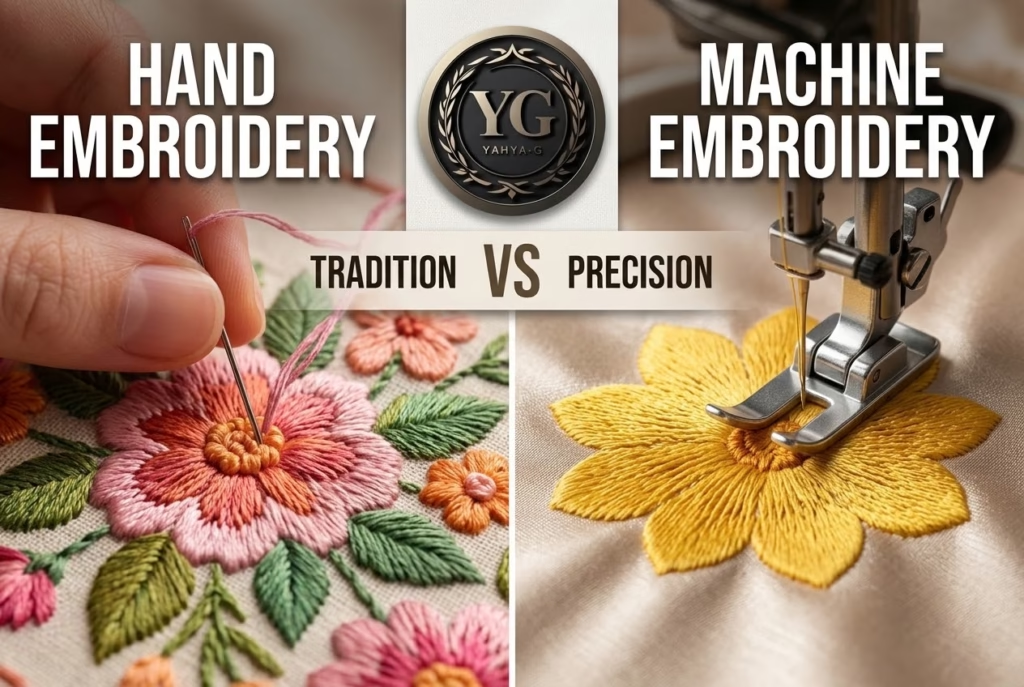
Embroidery has been used for centuries to transform fabric into something more expressive, personal, and distinctive. From intricate ceremonial garments to contemporary fashion, embroidery can add texture, character, and visual depth to an otherwise simple piece of clothing.
Today, however, there are two primary ways to create embroidered designs: hand embroidery and machine embroidery.
Both techniques have their place in modern tailoring and fashion. Hand embroidery offers the individuality and craftsmanship of manually placed stitches, while machine embroidery provides speed, consistency, and repeatability.
So, which is better?
The answer depends on the garment, design, occasion, budget, and the type of finish you want.
For luxury menswear—particularly Sherwanis, groom wear, Prince Coats, Jamawar garments, and other ceremonial clothing—understanding the difference can help you make a more informed choice.
What Is Hand Embroidery?
Hand embroidery is the traditional process of decorating fabric by placing each stitch manually using a needle and thread.
Unlike machine embroidery, the embroiderer controls the placement, direction, tension, and progression of the design by hand.
Different embroidery traditions use different techniques and materials, including:
- Satin stitch
- Chain stitch
- Cross-stitch
- French knots
- Metallic thread work
- Bead and sequin embellishment
- Traditional regional embroidery techniques
Because each stitch is individually placed, hand embroidery can have subtle variations in texture and execution. These variations are often considered part of its character. For ceremonial and bespoke garments, this handcrafted quality can make the embroidery feel particularly personal.
What Is Machine Embroidery?
Machine embroidery uses an embroidery machine to create a programmed design on fabric.
The design is generally prepared digitally and converted into instructions that tell the machine where and how to place the stitches.
Modern embroidery machines can produce highly detailed designs with remarkable consistency. They can also reproduce the same design across multiple garments, making machine embroidery particularly useful when uniformity and production efficiency are important.
Machine embroidery is commonly used for:
- Logos and branding
- Uniforms
- Corporate apparel
- Caps
- Shirts
- Repeated garment designs
- Bulk embroidery orders
- Decorative fashion applications
The machine handles the repetitive stitching process, while the operator remains responsible for preparing the design, selecting appropriate materials, setting up the machine, and ensuring the embroidery is produced correctly.
Hand Embroidery vs Machine Embroidery: Key Differences
| Feature | Hand Embroidery | Machine Embroidery |
| Stitching method | Each stitch is placed manually | Stitches are produced mechanically |
| Production speed | Generally slower | Generally faster |
| Design consistency | Can have subtle variations | Highly consistent |
| Individuality | Naturally suited to one-of-a-kind work | Excellent for repeatable designs |
| Texture | Can offer distinctive handmade texture | Typically more uniform |
| Customization | Highly flexible during execution | Depends on the digitized design |
| Bulk production | Time-intensive | Highly suitable |
| Labor requirement | Significant manual labor | Requires machine operation and setup |
| Best suited for | Bespoke, artistic, ceremonial and personalized work | Repeated designs, commercial and larger-volume work |
The important point is that one method is not universally superior to the other. Each solves a different problem.
1. Speed and Production Efficiency
This is one of the clearest differences.
Hand embroidery takes time because the design is built stitch by stitch. An intricate garment may require many hours of concentrated work, depending on the complexity of the design and the amount of embroidery required.
Machine embroidery can complete repetitive patterns considerably faster.
This makes machine embroidery particularly practical when the same design needs to be reproduced across many garments.
For example, if a business needs the same embroidered logo on hundreds of uniforms, machine embroidery offers an obvious production advantage.
For a single bespoke Sherwani, however, speed may not be the primary consideration.
2. Craftsmanship and Character
Hand embroidery has a quality that comes from the human hand.
Small variations in stitch direction, tension, texture, and placement can give the finished work a distinctive character. For some garments, these subtle variations are precisely what makes the embroidery feel artisanal.
Machine embroidery, by comparison, is designed around consistency.
Its strength is not natural variation but controlled repetition.
For clients seeking a highly individualized ceremonial garment, the handcrafted character of hand embroidery can be an important consideration.
3. Texture and Visual Depth
Embroidery is not only about the design itself. The way the stitches interact with the fabric also affects the finished appearance.
Hand embroidery can incorporate different stitching techniques and embellishment methods to create variation in texture and dimension.
Depending on the design, handwork can also be combined with materials such as beads, sequins, metallic elements, or other decorative details.
Machine embroidery can also produce intricate and attractive results, particularly when the design has been professionally digitized and the machine is correctly set up.
The final quality depends heavily on the design, fabric, thread, density, and execution.
4. Precision and Consistency
Machine embroidery has a major advantage when exact repetition is required.
Once a design has been properly digitized and tested, the same pattern can be reproduced with a high degree of consistency.
This is especially useful for:
- Brand logos
- Corporate uniforms
- Repeated motifs
- Production collections
- Standardized designs
Hand embroidery can also be extremely precise, but because each stitch is placed manually, subtle differences can naturally occur.
For bespoke fashion, however, those differences are not necessarily a flaw. They can contribute to the individuality of the garment.
5. Customization and Creative Flexibility
Hand embroidery provides significant freedom during the embroidery process.
An experienced artisan can adjust the design while working, change stitch techniques, modify details, or adapt the embroidery to the shape and construction of the garment.
This can be particularly valuable for one-of-a-kind garments.
Machine embroidery requires the design to be translated into a machine-readable format before production. Changes can certainly be made, but they generally require adjustments to the digital embroidery file and, in some cases, additional testing.
For highly personalized ceremonial wear, handwork therefore offers a different kind of creative flexibility.
Hand Embroidery for Sherwanis and Groom Wear
Embroidery plays an important role in South Asian ceremonial menswear.
A Sherwani, for example, can range from relatively understated embroidery to elaborate work covering significant portions of the garment.
For a groom’s outfit, embroidery may be used to highlight:
- The collar
- Front placket
- Cuffs
- Shoulders
- Chest
- Hemline
- Buttons
- Borders
- Coordinating accessories
Hand embroidery can be especially effective when the design requires detailed placement or an artisanal finish.
However, machine embroidery can also be an appropriate choice for certain designs, particularly when the desired look requires precise repetition or a specific geometric pattern.
The best approach depends on the design rather than simply choosing one technique for every garment.
Which Is More Expensive?
The cost of embroidery is influenced by several factors, including:
- Design complexity
- Amount of embroidery
- Fabric type
- Thread and embellishment materials
- Labor
- Production time
- Customization
- Number of garments
Hand embroidery often costs more when the design requires extensive manual labor because the artisan must spend significantly more time creating the piece.
Machine embroidery can reduce production time and therefore become more economical, particularly for repeated designs or larger orders.
For a bespoke garment, however, price should be considered alongside the level of customization and craftsmanship involved.
Does More Embroidery Mean a Better Garment?
Not necessarily.
Luxury tailoring is not about adding the maximum possible amount of decoration.
A sophisticated garment depends on balance.
The embroidery should complement:
- The fabric
- The silhouette
- The wearer’s proportions
- The occasion
- The color palette
- The overall design
An elaborately embroidered Sherwani may be appropriate for a wedding ceremony, while a more restrained design may be better suited to an engagement, reception, or formal evening event.
The goal is not simply to have more embroidery—it is to have the right embroidery.
Hand Embroidery vs Machine Embroidery: Which Should You Choose?
Your choice should begin with the purpose of the garment.
Choose Hand Embroidery When:
- You want a highly personalized garment.
- The piece is one-of-a-kind.
- You value artisanal craftsmanship.
- The embroidery requires individual adaptation.
- You want a distinctive handmade character.
- You are creating an important ceremonial or heirloom garment.
Choose Machine Embroidery When:
- You need faster production.
- The same design must be repeated.
- Consistency is a priority.
- You require embroidery across multiple garments.
- You are producing uniforms or branded apparel.
- The design is well suited to digital embroidery.
Consider Combining Both
The choice does not always have to be either hand or machine.
A garment can use machine embroidery for certain repetitive elements while incorporating hand-finishing for selected details.
This approach can combine production efficiency with handcrafted character.
For bespoke menswear, the final decision should be based on the garment’s design and the desired result.
What Matters More Than the Embroidery Method?
When purchasing a luxury embroidered garment, don’t evaluate it based on embroidery alone.
Consider the entire garment.
Fabric
The quality, weight, texture, and drape of the fabric influence how the embroidery will look and feel.
Fit
Even beautiful embroidery cannot compensate for a poorly fitted garment.
The shoulders, chest, sleeves, length, and overall proportions should work together naturally.
Design
The embroidery should complement the garment rather than overpower it.
Construction
The underlying construction and finishing are essential to the quality and longevity of the garment.
Detail Placement
On ceremonial menswear, the placement of embroidery matters just as much as the design itself.
A beautifully designed motif can lose its impact if it is positioned incorrectly.
The Role of Embroidery in Bespoke Tailoring
Bespoke tailoring gives the wearer greater control over the final garment.
Instead of selecting a standardized design, the client can work with the tailor to determine the overall direction of the garment, including:
- Fabric
- Color
- Collar style
- Front design
- Button selection
- Embroidery style
- Embroidery placement
- Thread colors
- Level of embellishment
- Fit and proportions
This is particularly valuable for wedding and ceremonial clothing, where the garment often needs to reflect the wearer’s personality and the significance of the occasion.
At Yahya G, embroidery is considered as part of the overall design rather than as an isolated decorative element.
Hand Embroidery vs Machine Embroidery: Frequently Asked Questions
Is hand embroidery better than machine embroidery?
Neither technique is universally better. Hand embroidery is suited to garments where individual craftsmanship and customization are important, while machine embroidery is highly effective when speed, consistency, and repeatability are required.
Is hand embroidery more expensive?
It can be, particularly when a design requires extensive manual labor. The final cost depends on the complexity of the work, materials, time, and overall garment construction.
Is machine embroidery good for Sherwanis?
Yes. Machine embroidery can be used effectively for many Sherwani designs, particularly patterns requiring consistency and repetition. The suitability depends on the specific design and desired finish.
Does hand embroidery last longer?
Durability depends on the quality of the embroidery, thread, fabric, construction, and care. The embroidery method alone does not determine how long a garment will last.
Can hand and machine embroidery be used together?
Yes. A garment can incorporate both techniques, using machine embroidery for certain elements and handwork for selected details.
Which embroidery is best for a groom’s Sherwani?
There is no single best method for every groom. The appropriate choice depends on the design, level of personalization, desired texture, budget, and overall aesthetic of the Sherwani.
How can I tell if embroidered clothing is well made?
Look at the consistency and cleanliness of the stitching, design placement, thread quality, fabric, construction, and overall fit. For a tailored garment, the embroidery should work harmoniously with the silhouette.
Final Thoughts
Hand embroidery and machine embroidery are not simply competing techniques. They are two different approaches to creating decorative textile work.
Hand embroidery brings time, craftsmanship, flexibility, and individual character to a garment. Machine embroidery brings efficiency, precision, consistency, and scalability.
For commercial production and repeated designs, machine embroidery can be extremely practical.
For bespoke, personalized, and ceremonial garments, hand embroidery can provide a distinctive artisanal quality.
Ultimately, the right choice is determined by the garment—not by the embroidery method alone.
At Yahya G, every element of a bespoke garment is considered as part of the complete design. From fabric and fit to embroidery and finishing, the objective is to create menswear that feels personal, refined, and appropriate for the occasion.
Create Your Bespoke Embroidered Garment with Yahya G
Whether you are looking for a custom Sherwani in Karachi, bespoke groom wear, a Prince Coat, Jamawar garment, or another piece of formal menswear, the right embroidery can transform the character of the final piece.
Yahya G
Shop #237, 2nd Floor, Dolmen Center, Tariq Road, Karachi
WhatsApp: 0312 525 4264
Bespoke Menswear. Thoughtful Details. Infinite Fashion.