
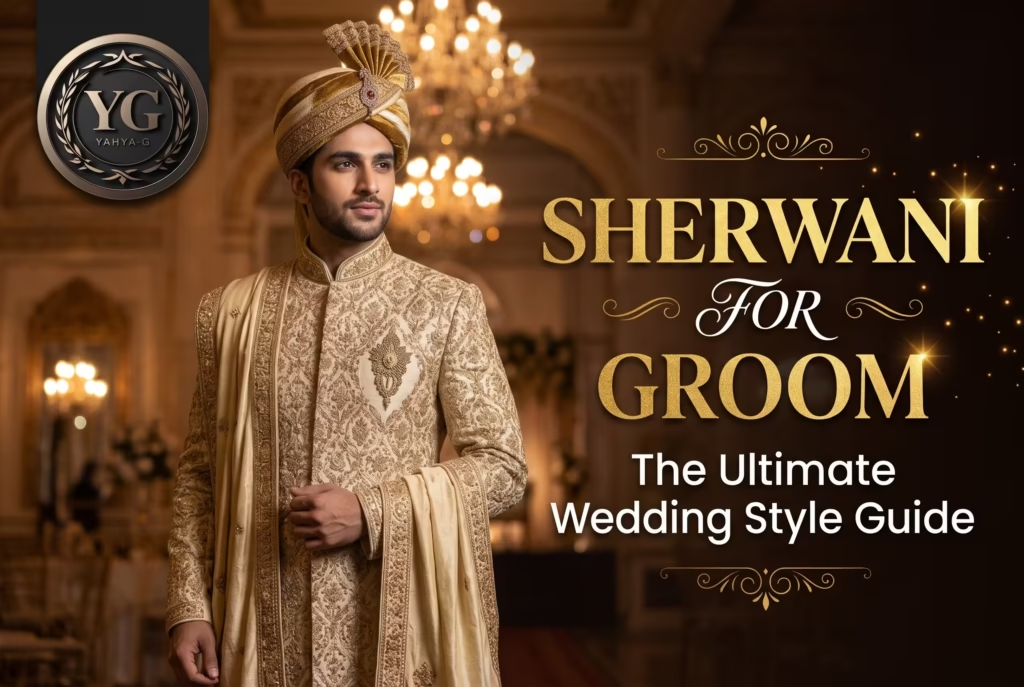
A wedding is one of the most memorable occasions in a man’s life. From the wedding ceremony and family celebrations to the photographs that will be treasured for years, every detail matters. Among these decisions, choosing the right wedding outfit deserves special attention.
For generations, the Sherwani has remained one of the most distinguished choices for grooms across Pakistan and South Asia. Its elegant silhouette, traditional craftsmanship, and rich detailing make it an ideal outfit for a groom who wants to look sophisticated while celebrating his cultural heritage.
However, selecting the perfect Sherwani involves more than choosing an attractive design. Fabric, colour, embroidery, fit, accessories, and personal style all contribute to the final appearance.
Whether you prefer a traditional ivory Sherwani with gold embroidery, a luxurious Jamawar design, or a contemporary Indo-Western silhouette, this guide will help you choose the right Sherwani for your wedding day.
What Is a Sherwani?
A Sherwani is a traditional South Asian men’s garment with a long, coat-like silhouette, typically featuring a front opening, structured shape, and a high or band-style collar.
It is commonly worn over a kurta, with accompanying bottoms such as churidar, fitted trousers, or other traditional styles.
The Sherwani is closely associated with formal celebrations, particularly weddings, where it represents elegance, tradition, and ceremonial dressing.
Over time, the garment has evolved. Traditional designs now coexist with contemporary interpretations featuring modern cuts, different collar styles, distinctive fabrics, and elaborate embroidery.
Today, the Sherwani remains a popular choice for Pakistani grooms who want an outfit that combines traditional character with individual style.
1. Choosing the Right Sherwani Fabric
Fabric is one of the most important decisions when selecting a wedding Sherwani. It determines how the garment drapes, feels, looks under lighting, and accommodates embroidery.
The ideal fabric depends on the wedding season, venue, design, and level of formality.
Raw Silk
Raw silk is a popular choice for traditional and contemporary Sherwanis.
Its natural texture and refined appearance create an elegant foundation for embroidery and decorative details.
Best for:
- Barat ceremonies
- Traditional groom wear
- Embroidered Sherwanis
- Formal wedding receptions
Jamawar
Jamawar is particularly associated with traditional South Asian luxury.
Its decorative woven patterns introduce richness and texture, making it an excellent choice for grooms who appreciate heritage-inspired clothing.
Best for:
- Traditional Barat Sherwanis
- Wedding waistcoats
- Prince Coats
- Richly detailed ceremonial outfits
Velvet
Velvet creates a distinctive, luxurious appearance because of its soft surface and rich texture.
Deep colours such as maroon, navy, emerald, and burgundy work particularly well for evening weddings and cooler weather.
Best for:
- Winter weddings
- Evening Barat ceremonies
- Royal-inspired groom outfits
- Statement Sherwani designs
Brocade and Jacquard
These fabrics feature decorative woven patterns that add visual interest without necessarily requiring extensive embroidery.
They are suitable for grooms who prefer a sophisticated design with a little more texture.
Best for:
- Formal wedding celebrations
- Contemporary traditional wear
- Subtle embroidered designs
- Elegant evening outfits
Cotton-Silk and Lightweight Blends
For warm-weather weddings, lighter fabrics can provide greater comfort.
Cotton-silk and suitable lightweight blends can offer an attractive appearance without the weight of heavier ceremonial fabrics.
Best for:
- Summer weddings
- Outdoor ceremonies
- Daytime Nikkah events
- Destination weddings
How to Choose Fabric According to the Season
| Wedding Setting | Recommended Fabrics | Styling Direction |
| Summer daytime | Lightweight silk blends, cotton blends | Light and breathable |
| Summer evening | Lightweight raw silk | Refined and elegant |
| Winter daytime | Raw silk, brocade | Traditional and structured |
| Winter evening | Velvet, heavier silk fabrics | Rich and luxurious |
| Outdoor wedding | Lightweight, comfortable fabrics | Practical and sophisticated |
Remember that comfort matters as much as appearance. Pakistani wedding celebrations can last several hours, so the fabric should suit the weather and venue.
2. Choosing the Perfect Sherwani Colour
Colour plays a major role in determining the personality of a groom’s outfit.
Traditional shades remain popular, but modern grooms have a much wider selection of colours.
Here are some of the most attractive choices.
Ivory, Cream, and Champagne
Style: Timeless, elegant and traditional.
Ivory and cream Sherwanis are among the most versatile choices for Pakistani grooms.
They look particularly elegant with gold embroidery, subtle metallic detailing, and traditional accessories.
Champagne adds a slightly warmer tone and can create a luxurious appearance without being excessively bright.
Maroon and Burgundy
Style: Regal, rich and traditional.
Maroon and burgundy are excellent choices for grooms who prefer deeper colours.
These shades work particularly well with gold, antique-gold, or subtle metallic embroidery.
They are especially suitable for evening Barat celebrations.
Navy and Midnight Blue
Style: Contemporary and sophisticated.
Navy and midnight blue offer a refined alternative to traditional bridal colours.
They work well with silver, antique-gold, and tonal embroidery.
These shades are particularly attractive for evening weddings and modern reception outfits.
Black
Style: Bold, modern and distinctive.
A black Sherwani can create a sharp and dramatic appearance.
Gold embroidery can make it feel more traditional, while subtle tonal detailing produces a minimalist contemporary look.
Pastel Colours
Style: Soft, modern and elegant.
Powder blue, mint, blush, sage, and light grey are popular options for grooms who prefer lighter wedding outfits.
These shades are particularly suitable for Nikkah, daytime celebrations, and Valima events.
Popular Sherwani Colour Combinations
| Sherwani Colour | Embroidery Colour | Overall Appearance |
| Ivory | Gold | Classic and royal |
| Champagne | Antique gold | Elegant and luxurious |
| Maroon | Gold | Traditional and rich |
| Navy | Silver | Modern and sophisticated |
| Black | Gold | Bold and distinctive |
| Emerald green | Antique gold | Regal and festive |
| Powder blue | Silver | Soft and contemporary |
| Beige | Champagne gold | Subtle and refined |
3. Popular Sherwani Styles for Grooms
Sherwanis are available in different silhouettes and design approaches. Choosing the right style depends on your personality, body proportions, and wedding occasion.
Classic Traditional Sherwani
Best for: Barat and traditional wedding ceremonies.
The classic Sherwani features a long, structured silhouette, a front button closure, and a traditional collar.
It is an excellent choice for grooms who appreciate heritage-inspired clothing.
Traditional embroidery, decorative buttons, and a coordinated turban can complete the look.
Indo-Western Sherwani
Best for: Contemporary grooms and modern wedding celebrations.
Indo-Western Sherwanis combine traditional elements with modern tailoring.
They may feature asymmetrical closures, updated proportions, layered designs, and contemporary detailing.
This style is suitable for grooms who want to preserve traditional character while expressing a more modern fashion identity.
Jodhpuri and Bandhgala Style
Best for: Refined formal occasions and minimalist wedding styling.
The Bandhgala is a distinct garment with a closed neckline and standing collar. It is often grouped with Sherwani-style groom wear because of its formal South Asian character.
It generally offers a shorter and more structured silhouette than a traditional long Sherwani.
It is an excellent alternative for grooms who prefer understated sophistication.
Heavily Embroidered Sherwani
Best for: Grand Barat ceremonies and statement wedding outfits.
Heavily embroidered Sherwanis feature decorative work across selected areas or much of the garment.
Common techniques include:
- Zardozi
- Dabka
- Tilla work
- Resham embroidery
- Beadwork
- Decorative metallic detailing
The embroidery can be concentrated around the collar, front panels, cuffs, shoulders, and hemline.
The key is to maintain balance between the fabric, embroidery, and overall silhouette.
Minimalist Sherwani
Best for: Nikkah, Valima and contemporary wedding styling.
Minimalist Sherwanis focus on clean lines, refined fabrics, subtle detailing, and excellent fit.
Rather than relying on extensive embroidery, these designs allow the quality of the fabric and tailoring to define the outfit.
They are particularly suitable for grooms who prefer understated elegance.
4. How to Choose a Sherwani According to Your Body Type
A well-designed Sherwani should complement your natural proportions rather than simply follow a particular fashion trend.
Custom tailoring makes it possible to adjust the silhouette, length, and detailing according to the individual.
For Slim Grooms
Structured fabrics and carefully placed embroidery can add visual definition.
Consider:
- Layered designs
- Textured fabrics
- Moderate embroidery
- Well-proportioned shoulders
- Balanced garment length
Avoid excessively loose designs that make the overall silhouette appear unstructured.
For Athletic Builds
An athletic build can work particularly well with a clean, tailored Sherwani.
Choose a design that follows the shoulders and chest without becoming restrictive.
A well-proportioned waist and comfortable sleeve construction help maintain a refined appearance.
For Broad or Heavier Builds
The objective should be a balanced silhouette rather than an excessively tight garment.
Consider:
- Structured but comfortable fabrics
- Clean vertical lines
- Balanced embroidery placement
- Well-proportioned collars
- Darker or tonal colour combinations
Avoid excessive bulk around the waist and chest.
For Shorter Grooms
Proportion is especially important.
Consider:
- A carefully selected Sherwani length
- Coordinated colours
- Controlled embroidery
- A clean vertical silhouette
- Well-fitted accompanying trousers
Avoid overly long or excessively elaborate designs that may overwhelm your proportions.
For Taller Grooms
Taller grooms can explore a wider range of lengths and layered designs.
Traditional long Sherwanis, statement embroidery, and coordinated shawls can work particularly well when the proportions are balanced.
5. Matching the Sherwani with the Bride’s Wedding Outfit
One of the most important styling decisions is how the groom’s outfit will coordinate with the bride’s dress.
Matching does not mean wearing identical colours. Instead, the objective is to create a harmonious combination.
Matching Colour Palettes
If the bride wears ivory and gold, an ivory Sherwani with complementary gold embroidery can create a coordinated appearance.
Similarly, pastel bridal wear can be complemented with champagne, powder blue, mint, or other related shades.
Contrasting Colours
Contrasting combinations can create a more distinctive wedding appearance.
For example:
- Red bridal lehenga with an ivory Sherwani.
- Maroon bridal outfit with a black Sherwani.
- Blush pink bridal dress with midnight navy.
- Emerald green bridal outfit with champagne.
Coordinate the Embroidery
Even when the base colours differ, shared embroidery colours can connect the outfits.
Gold, antique gold, silver, and complementary threadwork can create visual harmony.
Coordinate Accessories
A groom’s turban, Kullah, shawl, or brooch can repeat a colour found in the bride’s jewellery or outfit.
For a more detailed guide, read our article on Sherwani Matching or Contrasting: How to Style the Groom with the Bride at a Pakistani Wedding.
6. Choosing the Right Sherwani for Each Wedding Event
A groom does not necessarily need to wear the same style for every wedding function.
Different events provide opportunities to experiment with fabric, colour, and design.
| Wedding Event | Recommended Outfit | Styling Direction |
| Mayun | Kurta with waistcoat | Relaxed and festive |
| Mehndi | Colourful kurta or contemporary Sherwani | Vibrant and expressive |
| Nikkah | Ivory or pastel Sherwani | Elegant and understated |
| Barat | Traditional embroidered Sherwani | Grand and regal |
| Valima | Minimalist Sherwani or Prince Coat | Contemporary and refined |
Mayun and Mehndi
These events generally allow more relaxed and colourful styling.
Yellow, mustard, green, orange, and lighter shades can create a festive appearance.
Nikkah
For Nikkah, ivory, cream, champagne, and pastel colours are popular choices.
Subtle embroidery and clean tailoring can create a sophisticated outfit.
Barat
Barat is often the most elaborate wedding celebration.
Traditional Sherwanis featuring Jamawar, raw silk, rich embroidery, and coordinated accessories are popular choices.
Valima
Valima provides an opportunity for more contemporary styling.
A minimalist Sherwani, a refined Prince Coat, or a modern tailored outfit can create a distinguished appearance.
7. Accessories That Complete the Groom’s Sherwani
Accessories are important because they complete the traditional groom’s appearance.
However, every accessory should complement the Sherwani rather than compete with it.
Safa or Turban
A traditional Safa or turban can introduce colour, height, and ceremonial character.
Choose a shade that complements the Sherwani and the bride’s outfit.
Stole or Shawl
A decorative stole or shawl can add texture and movement.
It is particularly suitable for traditional Barat outfits and winter celebrations.
Brooch or Kalgi
A brooch or Kalgi adds a distinctive decorative touch.
Metallic finishes and gemstones can complement the embroidery and accessories.
Mala or Necklace
Pearl or gemstone malas are sometimes worn with traditional groom outfits.
Choose a design that suits the overall formality and does not overwhelm the Sherwani.
Khussa or Mojari
Traditional footwear such as Khussa or Mojari is a natural complement to many Sherwani designs.
Comfort is essential because wedding ceremonies often involve extended periods of standing, walking, and greeting guests.
Watch and Other Details
A classic watch can complete the look.
Keep additional accessories understated, especially when the Sherwani already features elaborate embroidery.
8. Custom Sherwani vs Ready-Made vs Rental
Choosing how to purchase your wedding Sherwani is another important decision.
Each option has advantages depending on your budget, schedule, and expectations.
| Factor | Custom Sherwani | Ready-Made Sherwani | Rental Sherwani |
| Fit | Developed around individual measurements | Standard sizing with possible alterations | Depends on available sizing |
| Fabric selection | Greater choice | Limited to available designs | Limited to rental collection |
| Design customization | High | Limited | Usually very limited |
| Availability | Requires production time | Usually immediate | Depends on availability |
| Cost | Varies with fabric and craftsmanship | Varies by brand and design | Usually lower initial expense |
| Best for | Personalized wedding outfits | Convenience and immediate needs | Budget-conscious, occasional use |
Why Consider Custom Sherwani Tailoring?
A custom Sherwani allows you to participate in important design decisions.
You can select:
- Fabric
- Colour
- Collar style
- Front design
- Button arrangement
- Embroidery
- Garment length
- Sleeve proportions
- Lining
- Accessories
The result is a garment designed around your measurements and preferences.
For an important wedding occasion, this level of personalization can make a meaningful difference.
When Should You Start?
Ideally, begin planning your custom Sherwani around two to three months before the wedding.
This provides time for fabric selection, design discussions, measurements, fittings, and final adjustments.
If your outfit includes elaborate hand embroidery or specialized fabric sourcing, additional time may be necessary.
9. Common Sherwani Mistakes Every Groom Should Avoid
Even a beautiful Sherwani can lose its impact if important details are overlooked.
Avoid these common mistakes:
- Ignoring comfort: Your wedding outfit should allow you to sit, walk, stand, and move naturally.
- Choosing trends over personal style: Select a design that suits your personality rather than copying another groom’s outfit.
- Leaving tailoring until the last minute: Embroidery, fittings, and adjustments require sufficient time.
- Ignoring the weather: Choose fabric weight and lining according to the season and venue.
- Overdoing embroidery: More decoration does not automatically mean better design.
- Selecting the wrong length: The Sherwani should complement your height and proportions.
- Forgetting footwear: Try your complete outfit with the intended footwear before the wedding.
- Skipping the final fitting: Always test the garment by sitting, walking, raising your arms, and moving naturally.
10. How to Make Your Sherwani Look Truly Royal
A royal appearance does not necessarily require the heaviest embroidery or the most expensive fabric.
It comes from the way all elements work together.
Consider these principles:
- Select a fabric that complements the occasion.
- Choose colours that suit your personality and wedding theme.
- Maintain balanced embroidery.
- Ensure the shoulders, chest, sleeves, and length are properly fitted.
- Coordinate accessories thoughtfully.
- Pay attention to footwear and grooming.
- Prioritize comfort alongside appearance.
The most impressive Sherwani is one that looks refined, feels comfortable, and reflects the groom’s individual style.
Frequently Asked Questions About Sherwanis for Grooms
Which Sherwani colour is best for a groom?
Ivory, cream, champagne, maroon, navy, and black are popular choices. The best colour depends on the wedding event, season, bride’s outfit, and personal preference.
Which fabric is best for a groom’s Sherwani?
Raw silk, Jamawar, brocade, jacquard, velvet, and suitable silk blends are popular options. Fabric weight and comfort should be considered according to the wedding season and venue.
Is a Sherwani suitable for a summer wedding in Pakistan?
Yes. Choose lightweight fabrics, breathable construction, and appropriate lining. Avoid unnecessarily heavy materials for long outdoor celebrations.
Should a groom match his Sherwani with the bride’s dress?
Matching is optional. You can choose similar colours, contrasting shades, or complementary embroidery and accessories. The goal is to create a coordinated appearance without making both outfits identical.
What is the difference between a Sherwani and a Bandhgala?
A Sherwani is generally a longer coat-style garment, while a Bandhgala is a more compact, structured jacket with a closed standing collar. Both are popular choices for formal South Asian menswear.
How long does custom Sherwani tailoring take?
The time depends on the fabric, design, embroidery, and tailoring requirements. Starting around two to three months before the wedding is a sensible approach, with additional time for elaborate designs.
Is a three-piece suit better than a Sherwani for a groom?
Both are excellent choices, but they create different appearances. A Sherwani offers traditional South Asian ceremonial styling, while a three-piece suit provides a Western formal silhouette. The wedding theme and personal preference should guide the decision.
Can a groom wear a Prince Coat instead of a Sherwani?
Yes. A Prince Coat can be an elegant alternative for Nikkah, Valima, and selected wedding celebrations. Its shorter, structured silhouette offers a more contemporary interpretation of traditional formal menswear.
Where can I get a custom Sherwani in Karachi?
You can explore bespoke Sherwani tailoring at Yahya G, where fabric, design, measurements, embroidery, and finishing can be considered according to your wedding requirements.
Final Thoughts: Choose a Sherwani That Reflects Your Personality
Your wedding Sherwani should represent more than a particular fashion trend. It should reflect your personal style, cultural heritage, and the significance of the occasion.
Whether you choose a traditional ivory Sherwani with gold embroidery, a richly detailed Jamawar design, a luxurious velvet outfit, or a contemporary minimalist silhouette, the most important elements remain fit, fabric, craftsmanship, and comfort.
A carefully tailored Sherwani can make you look distinguished without compromising your individuality.
Take time to explore different fabrics, discuss your preferred design, coordinate with your bride’s outfit, and arrange your fittings well before the wedding.
When every detail comes together, your wedding outfit becomes more than clothing. It becomes part of a memory that lasts a lifetime.
Create Your Wedding Sherwani with Yahya G
Looking for a custom Sherwani for groom in Karachi?
At Yahya G, we combine traditional tailoring expertise with contemporary menswear design to create personalized wedding outfits.
From classic Sherwanis and embroidered Barat attire to sophisticated Prince Coats and Jamawar designs, every garment is approached with attention to fit, fabric, proportions, and finishing.
Visit Yahya G to discuss your wedding outfit and explore bespoke tailoring options.
Yahya G
Shop #237, 2nd Floor, Dolmen Center, Tariq Road, Karachi.
WhatsApp: 0312 525 4264
Bespoke Menswear. Refined Craftsmanship. Infinite Fashion.