
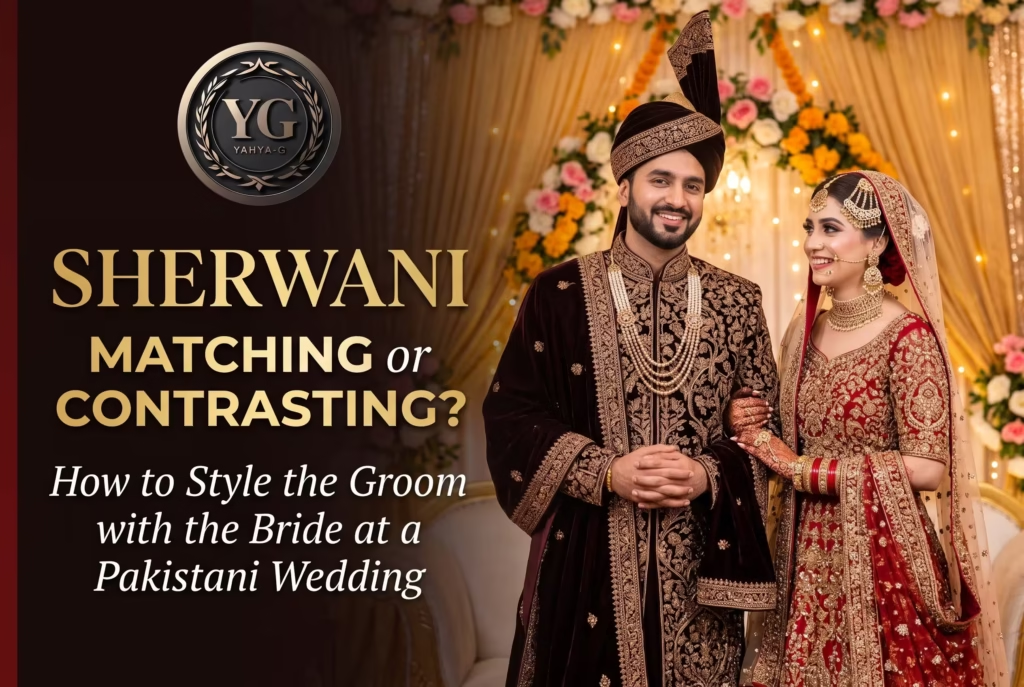
A Pakistani wedding is more than a single celebration. From Mayun and Mehndi to Nikkah, Barat, and Valima, every event has its own atmosphere, traditions, and dress code. While the bride’s outfit often receives considerable attention, the groom’s appearance is equally important in creating a beautifully coordinated wedding look.
One of the biggest decisions when selecting the groom’s outfit is whether his Sherwani should match the bride’s dress or contrast with it.
Should a groom wear an ivory Sherwani with an ivory bridal outfit? Does a traditional red bridal lehenga look better with a black, cream, or gold Sherwani? And how can couples coordinate their outfits without looking overly similar?
The answer depends on the wedding event, colour palette, embroidery, fabric, and personal style.
Both matching and contrasting combinations can look exceptional. The secret is to create visual harmony while allowing the bride and groom to maintain their individual identities.
In this guide, we explore how to choose the right Sherwani colour combination for Pakistani weddings, coordinate with the bride’s outfit, and create a sophisticated appearance for every wedding function.
1. Matching Sherwani with the Bride’s Outfit
Matching wedding outfits create a coordinated and harmonious appearance. However, matching does not necessarily mean wearing exactly the same colour.
Instead, it means choosing colours, embroidery, or decorative details that complement one another.
For example, an ivory Sherwani with gold embroidery can look beautiful beside an ivory bridal lehenga featuring similar gold detailing.
Why Choose Matching Wedding Outfits?
A coordinated appearance
Matching colours create a natural visual connection between the bride and groom. When the outfits share a colour palette, the couple looks thoughtfully styled together.
Beautiful wedding photography
Coordinated outfits can create elegant wedding photographs, particularly in traditional portrait settings where the bride and groom are photographed together.
Ideal for Nikkah and Valima
Soft colours such as ivory, champagne, blush pink, powder blue, and mint green are popular choices for elegant wedding styling.
A bride wearing dusty rose can be complemented by a groom in champagne, cream, or a subtle pink-toned Sherwani.
Works with themed wedding décor
If the wedding stage features ivory, peach, or pastel floral arrangements, coordinated outfits can complement the overall setting.
Popular Matching Sherwani Colour Combinations
| Bride’s Outfit | Groom’s Sherwani | Overall Appearance |
| Ivory and gold | Ivory with gold embroidery | Classic and elegant |
| Blush pink | Dusty pink or champagne | Soft and romantic |
| Mint green | Light sage or ivory | Fresh and sophisticated |
| Powder blue | Light blue or silver-grey | Modern and refined |
| Champagne gold | Beige or gold-toned Sherwani | Luxurious and coordinated |
| Deep maroon | Wine or burgundy | Traditional and rich |
Avoid Matching Too Closely
One potential problem with matching outfits is that the groom’s Sherwani can disappear beside the bride’s more elaborate bridal dress.
The solution is to coordinate the colour palette rather than reproduce the exact design.
For example, if the bride wears a deep wine lehenga with gold embroidery, the groom can choose a lighter champagne Sherwani with complementary gold detailing.
This maintains harmony while giving both outfits their own character.
2. Contrasting Sherwani with the Bride’s Outfit
For couples who prefer a more distinctive appearance, contrasting outfits offer an excellent alternative.
Instead of selecting similar colours, the groom chooses a shade that creates visual separation while still complementing the bride’s outfit.
Contrast can make the groom’s Sherwani stand out without competing with the bride’s bridal attire.
Why Choose Contrasting Outfits?
Individual identity
The bride and groom can express their personal preferences instead of wearing nearly identical colour combinations.
A stronger visual appearance
A darker Sherwani beside a lighter bridal outfit, or an ivory Sherwani beside a traditional red lehenga, can create a striking combination.
Balances heavily embroidered bridal wear
Pakistani bridal outfits often feature elaborate embroidery, rich colours, and decorative embellishments.
A groom wearing a more restrained Sherwani can create a balanced appearance.
Creates distinctive wedding photographs
Thoughtful colour contrast can make the couple’s outfits more visually interesting, particularly in formal portraits.
Popular Contrasting Sherwani Colour Combinations
| Bride’s Outfit | Groom’s Sherwani | Overall Appearance |
| Traditional red | Ivory or cream | Classic and elegant |
| Maroon | Black or charcoal | Bold and sophisticated |
| Blush pink | Midnight navy | Contemporary contrast |
| Gold | Deep green | Rich and regal |
| Emerald green | Champagne or beige | Refined and balanced |
| Peach | Deep brown or muted gold | Warm and distinctive |
| Powder blue | Charcoal | Modern and elegant |
How to Avoid Clashing Colours
Contrasting does not mean choosing two unrelated colours.
A successful combination should maintain some visual relationship between the outfits.
Consider these principles:
- Balance light and dark shades.
- Avoid combining too many competing bright colours.
- Coordinate embroidery colours where possible.
- Consider the bride’s jewellery and dupatta.
- Keep the groom’s accessories connected to the overall colour palette.
The goal is to create contrast without losing harmony.
3. Complementary Styling: The Best of Both Worlds
Matching and contrasting are not the only options.
Many couples achieve the most sophisticated results through complementary styling.
This approach allows the bride and groom to wear different base colours while sharing selected details.
Match the Embroidery, Contrast the Base Colour
A groom can wear a deep green or black Sherwani with gold Dabka or Zardozi embroidery, while the bride wears an ivory or champagne outfit featuring similar gold work.
The base colours are different, but the embroidery creates a connection.
Coordinate the Accessories
The groom’s turban, Kullah, shawl, or brooch can incorporate a colour found in the bride’s outfit or jewellery.
For example, if the bride’s jewellery features antique gold and emerald stones, the groom can introduce subtle gold and emerald details into his accessories.
Repeat One Accent Colour
Sometimes a single shared colour is enough.
If the bride’s dupatta features an emerald border, the groom can incorporate emerald into his pocket detail, shawl, or decorative accessory.
Coordinate Fabric and Texture
Fabric selection can also create visual harmony.
For example:
- Velvet with velvet creates a rich winter wedding appearance.
- Raw silk with raw silk creates a refined traditional combination.
- Jamawar details can connect two outfits without requiring identical colours.
- Similar metallic embroidery can create a coordinated finish.
Complementary styling is particularly useful when the bride prefers elaborate bridal wear while the groom prefers a simpler, more understated Sherwani.
4. Sherwani Matching Ideas for Every Pakistani Wedding Event
You do not need to follow the same styling approach for every wedding function.
Each event has its own mood, and the groom’s outfit can reflect that difference.
Mayun and Dholki: Relaxed and Traditional
Mayun and Dholki celebrations usually have a cheerful, relaxed atmosphere.
Yellow, mustard, orange, and pastel shades are popular choices for these occasions.
The groom can choose:
- A simple yellow or cream kurta.
- A pastel shalwar kameez.
- A lightweight waistcoat.
- A relaxed traditional outfit with subtle embroidery.
Matching the bride’s yellow or mustard colour palette creates a coordinated festive appearance without requiring a heavily embroidered Sherwani.
Mehndi: Colourful and Expressive
Popular styling direction: festive colours, embroidery and playful contrasts.
Mehndi is often the most colourful event of a Pakistani wedding.
Green, yellow, orange, mustard, and other vibrant shades are commonly incorporated into the bride’s outfit.
The groom can choose either matching or contrasting colours.
For example:
- Green Sherwani with gold embroidery.
- Mustard waistcoat with an ivory kurta.
- Cream Sherwani with green accessories.
- Black or deep green outfit against a vibrant bridal ensemble.
For Mehndi, the objective is to create a festive appearance while keeping the groom’s outfit comfortable.
Nikkah: Elegant and Understated
Popular styling direction: ivory, champagne, cream and soft pastels.
Nikkah outfits often favour elegance and simplicity.
Ivory, cream, champagne, blush pink, and powder blue are excellent choices for creating a refined appearance.
A groom can consider:
- An ivory Sherwani with subtle gold embroidery.
- A champagne Prince Coat.
- A cream outfit with a matching turban.
- A pastel Sherwani coordinated with the bride’s dress.
Matching or complementary styling works particularly well for this occasion.
Barat: Grand and Traditional
Popular styling direction: rich colours, traditional embroidery and statement tailoring.
Barat is often the most elaborate wedding event, and the groom’s Sherwani should reflect the importance of the occasion.
Traditional bridal colours such as red, maroon, and deep green can be complemented by several Sherwani shades.
Consider these combinations:
- Red bridal lehenga with an ivory Sherwani.
- Maroon bridal outfit with a black Sherwani.
- Deep red bridal dress with a champagne Sherwani.
- Emerald bridal outfit with an ivory or gold-toned Sherwani.
For a more traditional groom’s appearance, details such as a turban, Kullah, shawl, Dabka, and Zardozi embroidery can complete the look.
Valima: Contemporary and Sophisticated
Popular styling direction: modern tailoring, subtle embroidery and elegant colour coordination.
Valima styling often allows couples to experiment with contemporary silhouettes and softer colour combinations.
Popular choices include:
- Light grey Sherwani.
- Powder blue Prince Coat.
- Champagne or beige formal outfit.
- Ivory Sherwani with silver detailing.
- Navy or charcoal tailored formalwear.
For couples who prefer a coordinated appearance, pastel matching can look elegant. Those who want something more distinctive can choose complementary or contrasting colours.
5. How to Choose the Right Sherwani Fabric and Embroidery
Colour coordination is important, but fabric and embroidery also determine the overall quality of the groom’s outfit.
A beautifully selected colour combination can lose its impact if the fabric does not suit the design or occasion.
Popular Sherwani Fabrics
Jamawar
Jamawar is associated with traditional luxury and intricate woven patterns. It is particularly suitable for wedding Sherwanis, waistcoats, and Prince Coats.
Raw Silk
Raw silk offers a refined texture and structured appearance. It is a versatile choice for traditional and contemporary wedding outfits.
Velvet
Velvet creates a rich appearance and works particularly well for selected evening and winter wedding designs.
Silk Blends
Silk blends can offer a smooth, elegant finish and are available in a variety of textures and weights.
Brocade
Brocade fabrics feature decorative woven patterns and can add visual richness to a traditional Sherwani.
Popular Embroidery Techniques
The embroidery should complement the fabric and overall design.
- Dabka: Adds traditional metallic detailing.
- Zardozi: Creates decorative embroidery using metallic threads and embellishments.
- Resham work: Introduces coloured thread designs.
- Tilla work: Adds a distinctive metallic embroidered finish.
- Beadwork: Provides additional texture and decorative detail.
The amount of embroidery should reflect the occasion and the groom’s personal style.
A heavily embroidered Sherwani may be appropriate for Barat, while a cleaner design may be more suitable for Nikkah or Valima.
6. The Importance of Sherwani Fit
Even the most expensive fabric and elaborate embroidery cannot compensate for an incorrect fit.
A groom’s Sherwani should complement his body proportions and allow comfortable movement throughout the wedding.
Pay attention to the following details:
Shoulders: The shoulder line should sit naturally without looking too wide or restrictive.
Chest: The Sherwani should provide enough room for comfortable movement while maintaining a clean silhouette.
Sleeves: Sleeve length should be appropriate, with enough freedom for natural arm movement.
Length: The overall length should complement the groom’s height and the style of the outfit.
Buttons and closure: The front should fasten comfortably without pulling or creating unwanted creases.
Trousers or bottoms: The accompanying trousers, churidar, or other traditional bottoms should complement the Sherwani’s silhouette.
For a wedding outfit, custom tailoring is particularly valuable because it allows the garment to be designed around the groom’s measurements rather than relying entirely on standard sizing.
7. Groom Accessories That Complete the Wedding Look
Accessories can connect the groom’s outfit with the bride’s without requiring the Sherwani itself to match her dress.
Turban or Kullah
A turban or Kullah can introduce a complementary colour or traditional detail.
Shawl
A carefully selected shawl can add texture and elegance, particularly for Barat and winter weddings.
Brooch
A subtle brooch can introduce a metallic or gemstone accent that complements the bride’s jewellery.
Footwear
Traditional khussas and formal ethnic footwear can complete the Sherwani look.
Jewellery and Embellishments
Keep decorative elements balanced. The accessories should complement the Sherwani rather than compete with its embroidery.
8. Important Things to Consider Before Choosing Matching or Contrasting Outfits
Before finalizing the groom’s Sherwani, consider the following factors.
Finalize the Bride’s Outfit First
The bride’s outfit often involves extensive decisions about colour, embroidery, jewellery, and silhouette.
Once the bridal outfit is finalized, the groom can select a Sherwani that complements its overall design.
Consider the Wedding Venue
The venue and stage décor can influence how colours appear.
An ivory Sherwani may look beautiful against a rich floral backdrop, while a darker outfit can create stronger contrast in a brightly decorated hall.
Think About Lighting and Photography
Daylight and artificial lighting can change the appearance of fabrics and colours.
A shade that looks soft in a showroom may appear brighter or darker under wedding stage lighting.
Always examine both outfits together under different lighting conditions.
Consider the Season
Pakistani weddings take place throughout the year, and comfort should be part of the decision.
For warmer weather, consider breathable fabrics and appropriate lining. For winter weddings, richer fabrics and heavier textures may be more comfortable.
Prioritize Personal Style
The bride and groom should feel confident in their outfits.
Do not choose matching colours simply because they are popular, and do not select a dramatic contrast if it does not reflect your personality.
The best wedding styling is one that feels natural to both people.
9. Matching vs Contrasting: Which Is Better?
Here is a quick comparison to help make the decision.
| Consideration | Matching | Contrasting |
| Overall appearance | Coordinated and harmonious | Distinctive and dramatic |
| Best for | Soft, elegant styling | Bold, individual styling |
| Popular events | Nikkah and Valima | Barat and selected receptions |
| Photography | Creates visual continuity | Creates stronger colour separation |
| Colour selection | Similar or related shades | Different but complementary shades |
| Styling approach | Shared colour palette | Balanced contrast and shared details |
Neither approach is universally better.
Matching works beautifully when the couple wants a coordinated appearance. Contrasting is ideal when both want their individual outfits to stand out.
Complementary styling offers an excellent middle ground.
Frequently Asked Questions About Sherwani Matching and Contrasting
Should the groom’s Sherwani match the bride’s dress?
It does not have to match exactly. The groom can choose a similar colour, a complementary shade, or a contrasting colour that works with the bride’s outfit. The important thing is that both outfits look harmonious together.
Which Sherwani colour goes best with a red bridal lehenga?
Ivory, cream, champagne, black, and selected gold-toned shades can complement a traditional red bridal lehenga. The best option depends on the embroidery, jewellery, and overall styling.
What should a groom wear with a maroon bridal dress?
A champagne, ivory, black, or deep wine Sherwani can work well with a maroon bridal outfit. Gold embroidery can help connect the two looks.
Should the groom wear the same colour as the bride on Barat?
No. Matching is a personal styling choice rather than a requirement. Many grooms prefer contrasting colours on Barat to create a distinctive appearance alongside the bride’s traditional outfit.
What Sherwani colour is best for Nikkah?
Ivory, cream, champagne, blush, and soft pastel shades are popular choices for an elegant Nikkah look. The groom can match or complement the bride’s outfit.
Can the groom wear black Sherwani with a red bridal dress?
Yes. A black Sherwani with subtle gold or metallic embroidery can create a strong and sophisticated contrast with a red bridal outfit.
How can the bride and groom coordinate outfits without wearing the same colour?
They can share embroidery colours, accessory details, fabric textures, or a single accent shade. Coordinating the turban, shawl, brooch, or jewellery-inspired details can create visual harmony without identical outfits.
Is a custom Sherwani better for a wedding?
Custom tailoring offers greater control over measurements, fabric, colour, embroidery, and design details. It can be particularly useful for grooms who want an outfit developed around their personal style and wedding requirements.
Final Thoughts: Create a Wedding Look That Belongs to Both of You
When deciding between matching and contrasting Sherwanis, remember that the goal is not simply to wear similar colours. It is to create a wedding appearance in which both outfits complement one another.
Matching creates harmony and elegance. Contrasting adds individuality and visual impact. Complementary styling brings together the best elements of both approaches.
For Nikkah and Valima, soft matching or complementary colours can create a refined appearance. For Barat, a contrasting Sherwani can balance the bride’s elaborate bridal outfit and allow the groom to make his own statement.
Ultimately, the best combination is one that reflects the couple’s personalities, suits the wedding occasion, and feels comfortable throughout the celebrations.
A beautifully coordinated wedding look does not require identical outfits. Sometimes, one shared colour, a similar embroidery detail, or a carefully selected accessory is enough to bring two completely different designs together.
Design Your Wedding Sherwani with Yahya G
Looking for a custom Sherwani in Karachi that complements your bride’s wedding outfit?
At Yahya G, bespoke menswear combines traditional craftsmanship, carefully selected fabrics, refined embroidery, and personalized tailoring to create Sherwanis designed around the groom’s style and occasion.
Whether you prefer a classic ivory Sherwani, a richly embroidered Barat outfit, a contemporary Prince Coat, or a distinctive contrasting design, every detail can be considered as part of your wedding look.
Yahya G
Shop #237, 2nd Floor, Dolmen Center, Tariq Road, Karachi
WhatsApp: 0312 525 4264
Bespoke Menswear. Wedding Elegance. Infinite Fashion.